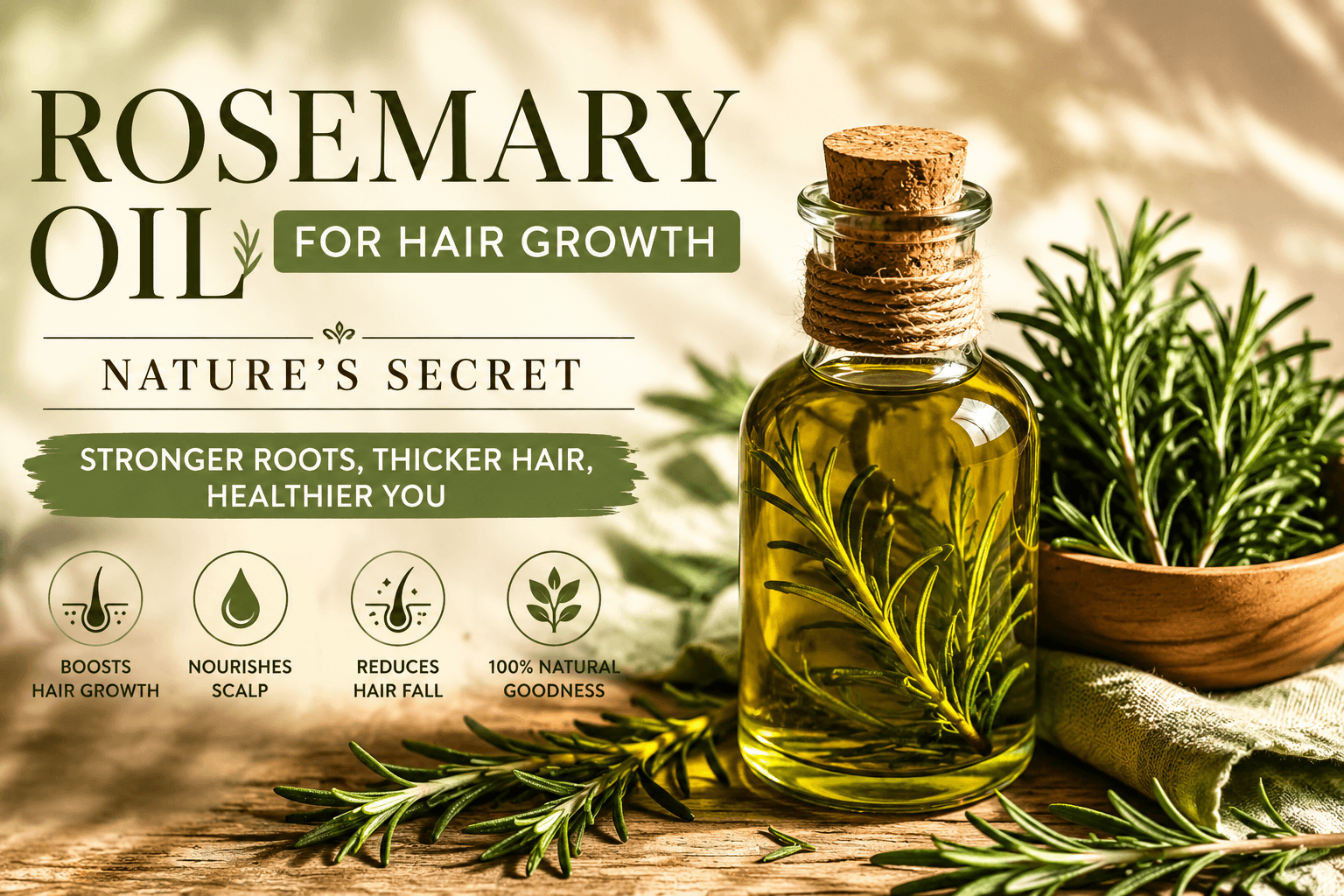
Rosemary Oil for Hair Growth: Benefits, How to Use It, vs Minoxidil, and the Best Oils to Buy
Your Hair Is Thinning — And You’re Tired of Products That Promise Everything and Deliver Nothing. You’ve tried the expensive shampoos. The biotin supplements. The scalp serums that smell like a chemistry lab and cost like a luxury handbag. And your hair? Still not where you want it. So now rosemary oil for hair growth keeps showing up — on your For You page, in your Pinterest saves, in every “natural hair growth” article you’ve clicked at midnight. And you’re wondering: is this actually real, or is it just another trend?
Here’s the honest answer: rosemary oil for hair growth is one of the most well-supported natural remedies out there. Not influencer-supported. Actually research-supported. And this guide is going to tell you exactly why it works, how to use it correctly, and which products are worth buying — on Amazon and AliExpress — so you’re not wasting money on the wrong thing. Everything you need is in here. Keep reading.
What Is Rosemary Oil?
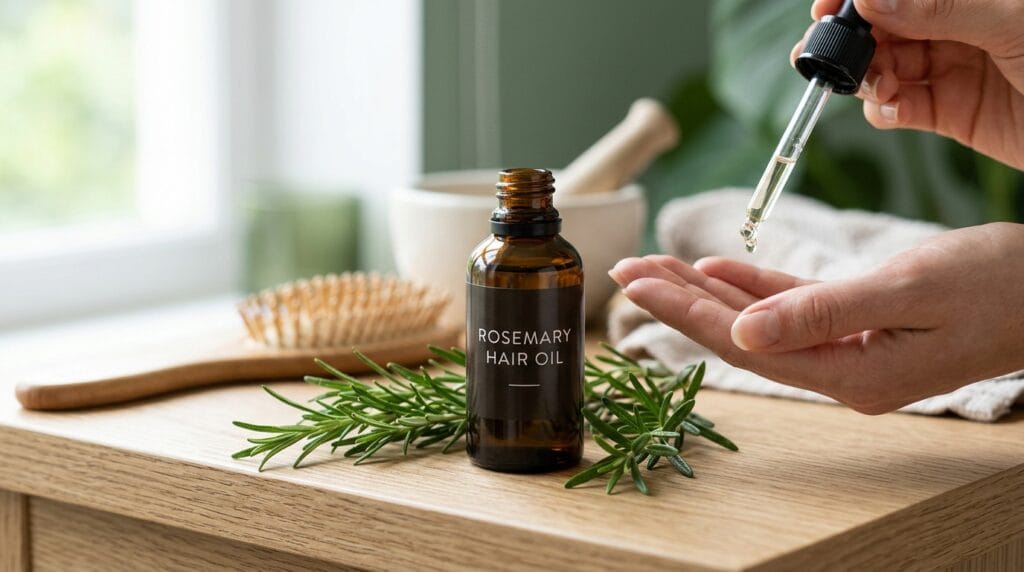
Rosemary oil is an essential oil extracted from Rosmarinus officinalis — the same herb sitting in your kitchen. Through steam distillation, the plant’s active compounds are concentrated into a potent oil that has been used in traditional medicine for centuries.
The compounds that matter most for hair: 1,8-cineole (also called eucalyptol), rosmarinic acid, camphor, and alpha-pinene. These aren’t marketing words — they’re the bioactive components that drive the results you’re about to read about.
One important thing to know upfront: rosemary oil is an essential oil, which means it is highly concentrated and should almost never be applied directly to the scalp without diluting it first in a carrier oil. More on that in the how-to section.
Does Rosemary Oil Actually Work for Hair Growth?
Let’s address the real question — because you deserve a straight answer, not a hedged non-answer. Yes. There is genuine research behind this.
The most cited study compared rosemary oil directly to 2% minoxidil — one of the only FDA-approved hair growth treatments — over a 6-month period in people with androgenetic alopecia (the most common form of hair loss). Both groups saw similar improvements in hair count by the end of the study. The rosemary group also reported significantly less scalp itching than the minoxidil group.
That’s a meaningful finding. It doesn’t mean rosemary oil is a miracle cure for every type of hair loss, and it won’t work overnight — the study ran for six months. But it does mean this isn’t just wellness-world hype. There’s a real mechanism at work.
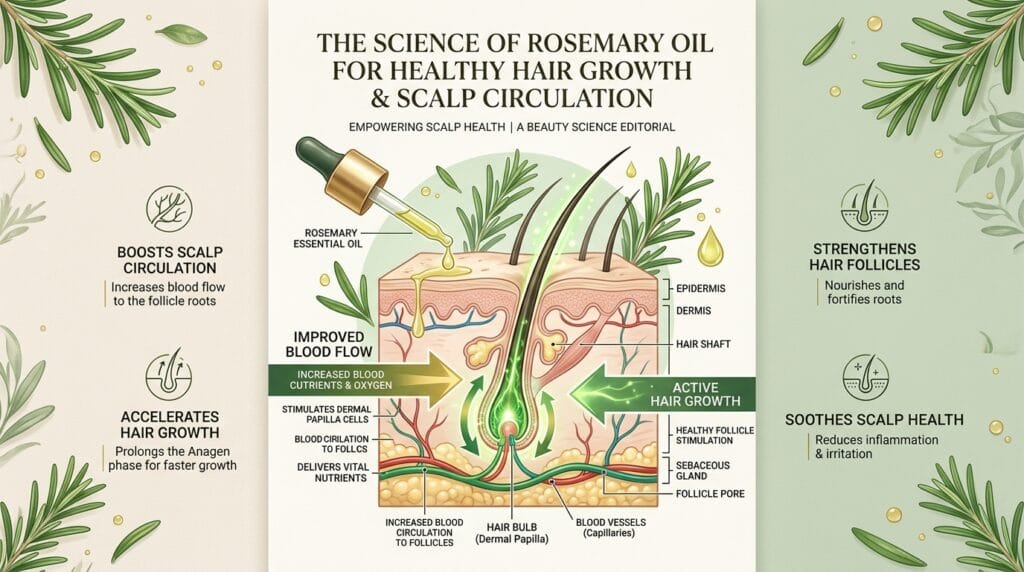
How does it work? The leading explanation is that rosemary oil improves microcirculation in the scalp — meaning it increases blood flow to the hair follicles. Better blood flow means more oxygen and nutrients reaching the follicle, which can stimulate growth and slow shedding. Some research also suggests rosemary oil may have mild DHT-inhibiting properties — relevant because DHT (dihydrotestosterone) is the hormone primarily responsible for androgenetic hair loss in both men and women.
What it won’t do: It won’t regrow hair from completely dead follicles. If a follicle has been dormant for years, no topical oil will revive it. Rosemary oil works best as a preventative and early-stage intervention — keeping active follicles healthy and stimulated.
How long does it take? Be patient. Most people begin noticing reduced shedding within 4–8 weeks of consistent use. Visible new growth typically takes 3–6 months. Consistency is everything.
Rosemary Oil vs Minoxidil: Which Actually Grows Hair?
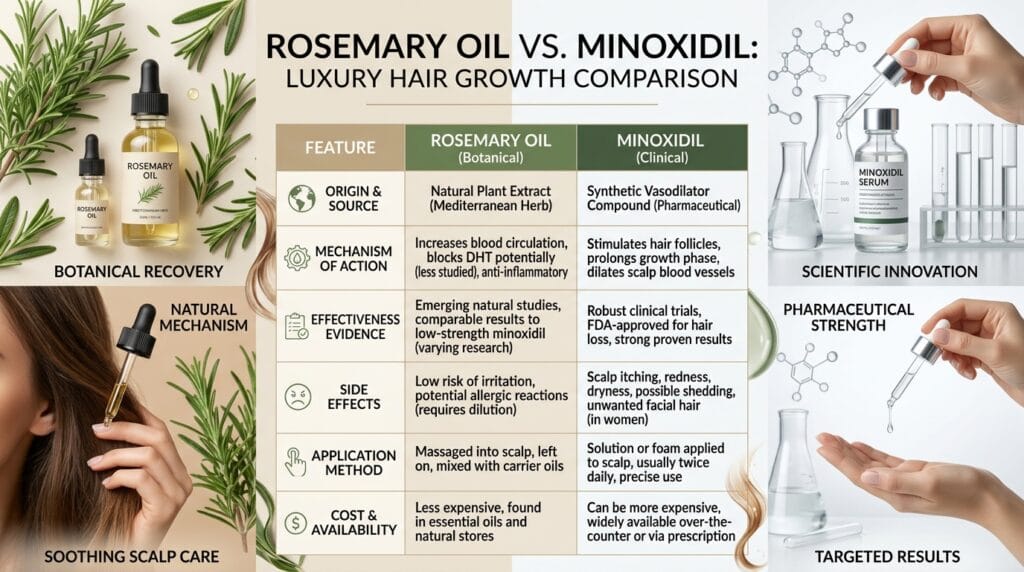
This is the question everyone is really asking. Both work. But they work differently, cost differently, and suit different people. Here is exactly how they compare:
Head-to-Head Comparison
Rosemary Oil | Minoxidil | |
|---|---|---|
How it works | Improves scalp blood circulation, mild DHT inhibition | Widens blood vessels, prolongs hair growth phase |
Proven by research | Yes — 2015 study vs 2% minoxidil | Yes — FDA approved |
How long to see results | 3–6 months | 3–6 months |
Application | Scalp massage, 2–3x per week | Daily — cannot skip |
Cost | Low — £6 to £20 per bottle | Medium to high — ongoing prescription or OTC cost |
Side effects | Minimal — mild irritation if undiluted | Scalp itching, dryness, initial shedding, possible unwanted facial hair |
What happens if you stop | Shedding may gradually return | Hair loss returns within months — faster than rosemary |
Best for | Early to moderate thinning, DHT-related loss, natural preference | Moderate to advanced androgenetic alopecia |
Available without prescription | Yes — everywhere | Yes (2% and 5% OTC), higher strengths need prescription |
Can combine both | Yes — safe to use together | Yes — many dermatologists recommend combining |
So Which One Actually Grows Hair?
Both do — but here is the honest breakdown:
Choose rosemary oil if you are in the early stages of thinning, prefer a natural approach, have a sensitive scalp, or want something sustainable and low-cost for the long term. It is also the smarter starting point if you are not sure yet whether your hair loss is serious enough for medication.
Choose minoxidil if your hair loss is more advanced, you have been thinning for several years, or you need faster and more aggressive results. Minoxidil has a larger body of clinical evidence and works on more severe cases than rosemary oil alone can address.
Use both if you want maximum results. Rosemary oil and minoxidil work through completely different mechanisms — combining them is safe and many dermatologists actively recommend it. Rosemary oil handles scalp health and DHT; minoxidil handles follicle stimulation. Together they cover more ground than either does alone.
The one thing minoxidil does that rosemary oil cannot: minoxidil is significantly more effective for advanced or long-standing hair loss. If your hairline has been receding for five-plus years, rosemary oil alone is unlikely to reverse that. Be honest with yourself about where you are — and if in doubt, see a trichologist before choosing.
The Side Effect Difference — And Why It Matters
This is where rosemary oil has a clear, documented advantage. In the 2015 study that compared the two directly, both groups saw similar hair count improvements — but the minoxidil group reported significantly more scalp itching and irritation throughout the trial.
Minoxidil can also cause an initial shedding phase in the first 2–4 weeks — where hair falls out more before it grows back. This is normal and temporary, but it is alarming if you are not expecting it. Rosemary oil does not cause this.
For anyone with a sensitive scalp, a history of contact dermatitis, or simply a low tolerance for side effects — rosemary oil is the gentler, more comfortable path to the same destination.
Rosemary Oil Benefits for Hair
Beyond hair growth, here’s what rosemary oil actually does for your hair and scalp:
1. Stimulates Hair Follicles By improving blood circulation to the scalp, rosemary oil delivers more nutrients to each follicle — keeping existing hair in the growth phase longer and potentially activating resting follicles.
2. Reduces Hair Shedding Regular scalp massage with rosemary oil (combined with the oil’s follicle-stimulating effects) can visibly reduce the amount of hair coming out in the shower or brush over time.
3. Fights Dandruff and Scalp Build-Up Rosemary oil has natural antimicrobial and antifungal properties. This makes it effective against the Malassezia yeast that contributes to dandruff and seborrheic dermatitis — both of which can worsen hair thinning if left untreated.
4. May Help Block DHT Some compounds in rosemary oil — particularly rosmarinic acid — show evidence of mild DHT-inhibiting activity. Since DHT is the primary driver of pattern hair loss, this is a meaningful benefit for anyone dealing with thinning at the temples or crown.
5. Adds Shine and Reduces Frizz As a side benefit: rosemary oil, when used in small amounts, can smooth the hair cuticle and add a healthy-looking shine. Your hair looks better even before the growth kicks in.
6. Soothes an Irritated or Itchy Scalp The anti-inflammatory compounds in rosemary oil — particularly 1,8-cineole — calm scalp irritation, redness, and itching. If your scalp feels tight, dry, or sensitive, this is a particularly useful benefit.

How to Use Rosemary Oil for Hair Growth
This is the section most people skip — and then wonder why the oil isn’t working. Application method matters enormously. Here are the three most effective ways to use rosemary oil for hair growth:
Method 1: Scalp Massage with Carrier Oil (Most Effective)
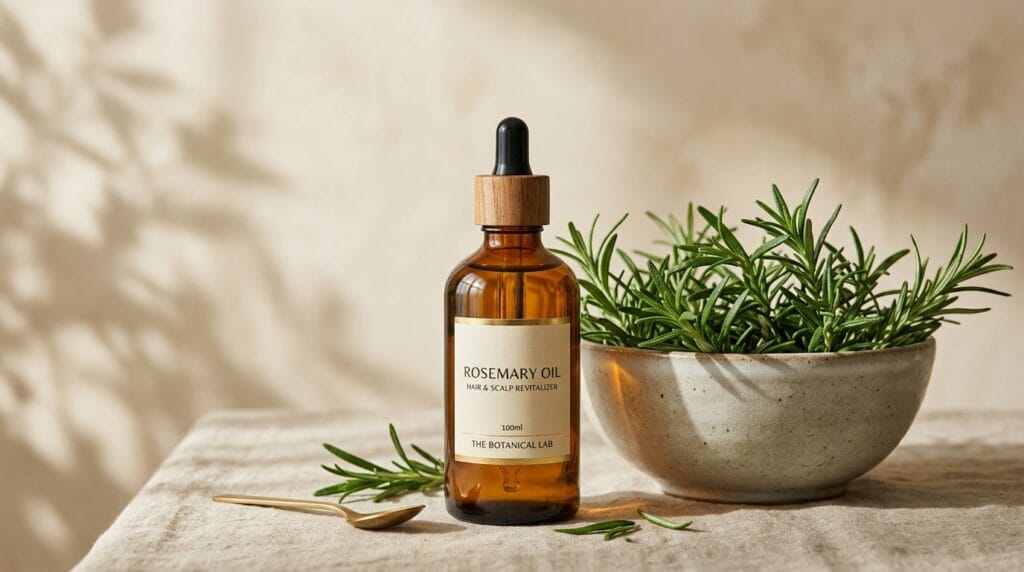
This is the method used in the clinical research and the one that delivers the best results. The scalp massage itself improves circulation; combined with the rosemary oil, the effect is compounded. How often: 2–3 times per week for best results.
What you need:
- 2–3 drops of rosemary essential oil
- 1 tablespoon of carrier oil — jojoba, coconut, argan, or sweet almond all work well
How to do it:
- Mix your rosemary oil drops into the carrier oil in your palm or a small bowl. Never skip the carrier oil — undiluted essential oil on the scalp can cause irritation or chemical burns.
- Section your hair to expose the scalp directly.
- Apply the mixture to your scalp using your fingertips — not the lengths of your hair.
- Massage firmly in circular motions for 4–5 minutes. This step is not optional. The massage itself is part of what drives results.
- Leave on for at least 30 minutes — or overnight for a deeper treatment. Cover with a shower cap if leaving overnight.
- Wash out with your regular shampoo. You may need two rounds of shampoo to remove coconut oil completely.
Method 2: Add to Your Shampoo or Conditioner (Easiest)
Lower effort, slightly lower impact — but still effective for daily maintenance and scalp health. Who this works for: People who want a low-effort daily habit, or who travel frequently and can’t manage a full oil treatment routine.
How to do it:
- Add 5 drops of rosemary essential oil per 100ml of your regular shampoo or conditioner. Mix well.
- Use as normal. When shampooing, spend an extra 60 seconds massaging your scalp before rinsing.
- Don’t rinse immediately — leave the shampoo on for 2–3 minutes to allow absorption.
Method 3: DIY Rosemary Water Spray (Trending, Budget-Friendly)
Rosemary water sprays have become one of the most shared hair growth hacks on TikTok and Pinterest — and the science behind them is reasonable, even if less potent than direct oil application. Spray directly onto the scalp after washing, on damp hair. Massage in gently. Do not rinse out. Best for: Daily use between oil treatments. Also great for fine hair that can’t handle heavy oils.
How to make it:
- Bring 2 cups of water to a boil.
- Add a generous handful of fresh rosemary sprigs (or 3–4 tablespoons of dried rosemary).
- Simmer for 20–30 minutes. The water will turn a light yellow-green colour.
- Cool completely, strain, and pour into a spray bottle.
- Store in the fridge — use within 1 week, or add a few drops of rosemary essential oil as a natural preservative to extend shelf life to 2–3 weeks.
Best Rosemary Oil for Hair Growth: Our Top Amazon Picks
Shopping for the best rosemary oil for hair growth on Amazon means choosing between pure essential oils (which you dilute yourself) and pre-made scalp serums (ready to use). Both work — your choice depends on your routine and budget. Here are our picks across every category:
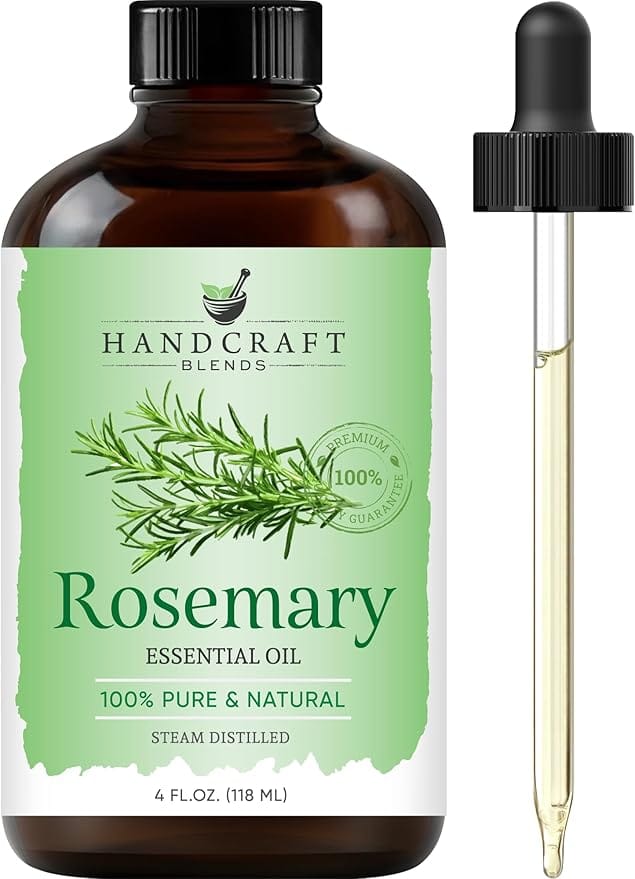
1. Handcraft Blends Rosemary Essential Oil — 100% Pure & Natural
⭐ Best for: Best value per drop | Maximum quantity | DIY blends | Shampoo mixing | Serious long-term users
Over 10,000 Amazon reviews don’t lie. Handcraft Blends’ rosemary essential oil is the bestselling pure rosemary oil on Amazon for a reason — and that reason is simple. 100% pure Rosmarinus officinalis, steam distilled, zero additives, zero fillers, zero synthetic chemicals. What’s in the bottle is exactly what the label says. Nothing more, nothing less.
Why we love it: The 4 Fl Oz / 118ml bottle is four times larger than most competitor pure oils at a fraction of the price difference — giving you significantly more treatments per pound or dollar spent. Amazon’s Choice badge with 10,000+ verified reviews makes this the most trusted pure rosemary essential oil on this entire list. For anyone committed to a consistent scalp massage routine, this is the smartest bulk buy available.
Who it suits: Anyone who wants maximum quantity at maximum value — long-term users, people mixing into shampoo daily, or those making their own rosemary water spray and DIY scalp blends. Also perfect if you want to try multiple hair growth application methods without running out mid-routine.
What to know: Pure essential oil — must be diluted before scalp application. Standard dilution is 2 drops per teaspoon of carrier oil such as jojoba oil, coconut oil, or argan oil. Do not apply undiluted essential oil directly to scalp — risk of contact dermatitis and scalp irritation.
2. Mielle Organics Rosemary & Mint Scalp & Hair Strengthening Oil
⭐ Best for: Beginners | Ready-to-use | Natural hair types | All-in-one treatment
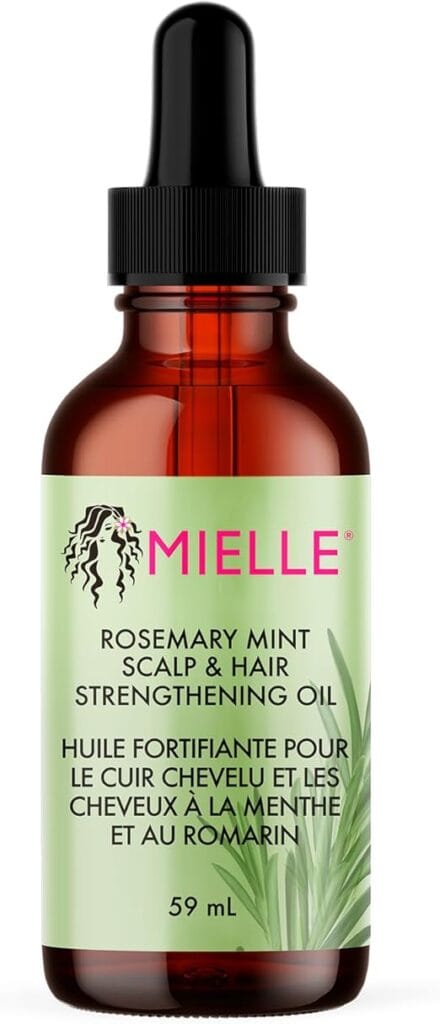
Most rosemary oils give you one or two ingredients. Mielle gives you thirty.
- Rosmarinus Officinalis Leaf Oil sits at the core — but what surrounds it is what makes this formula genuinely special. This is a complete botanical scalp treatment in one bottle, built across four ingredient layers:
- Carrier Oil Base: Castor Oil for thickness and strength, Jojoba Oil to mimic the scalp’s natural sebum, Grapeseed Oil for lightweight absorption, plus Coconut, Sweet Almond, Safflower, and Rice Bran oils for deep nourishment.
- Essential Oil Complex: Peppermint Oil and Menthol create the signature cooling tingle on application. Tea Tree Oil and Eucalyptus Oil keep the scalp clean and antimicrobial. Lavender and Sage soothe irritation.
- Active Ingredients: Biotin for keratin production, Vitamin E for antioxidant scalp protection, Vitamin C for collagen synthesis, and Vitamin D to support healthy follicle cycling.
- Plant Extracts: Nettle Extract as a natural DHT inhibitor, Horsetail Extract for strand strength via silica, Burdock Root for scalp detox, and Aloe Vera to calm inflammation.
Why we love it: Ready to apply directly — no diluting, no mixing. Dropper applicator for precise, mess-free scalp delivery.
Who it suits: Natural, coily, or dry hair types needing growth support plus deep nourishment. Contains Soybean, Wheat, and Celery derivatives — patch test if you have food-based allergies.
What to know: Fragrance is present — sensitive scalp types should patch test 24 hours before full application.
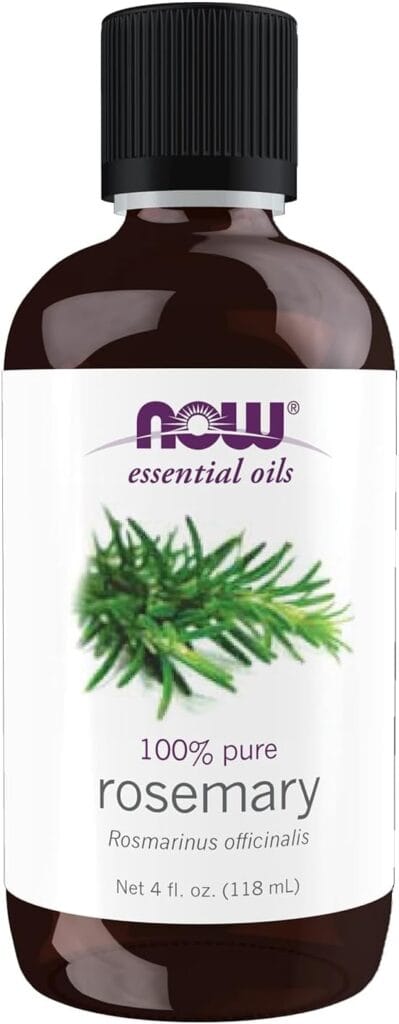
3. NOW Solutions Rosemary Essential Oil — 100% Pure (1oz/30ml)
⭐ Best for: First-time buyers | Patch testing | Shampoo mixing | Maximum purity seekers
One ingredient. That’s it. No carrier oils, no added fragrance, no fillers or synthetic chemicals. Just 100% pure Rosmarinus officinalis — steam distilled, nothing added, nothing removed. If you want rosemary oil in its most honest, most potent form, this is exactly that.
Why we love it: NOW Foods has been one of the most trusted names in essential oils and supplements for decades. Their rosemary oil is third-party tested for purity — what the label says is what’s in the bottle. For anyone who has ever bought an essential oil and wondered “is this actually pure?” — NOW removes that doubt completely.
Who it suits: Perfect for first-time rosemary oil users who want to test their scalp’s response before committing to a larger bottle. Also ideal for people who already have a favourite carrier oil and want full control over their blend — mix your own dilution ratio, add to your shampoo, or make your own rosemary water spray.
What to know: This is a pure essential oil — it must be diluted before scalp application. The 1oz size is intentionally a starter size. Once you know it works for you, the larger 4oz bottle (also available from NOW) gives significantly better value per drop.
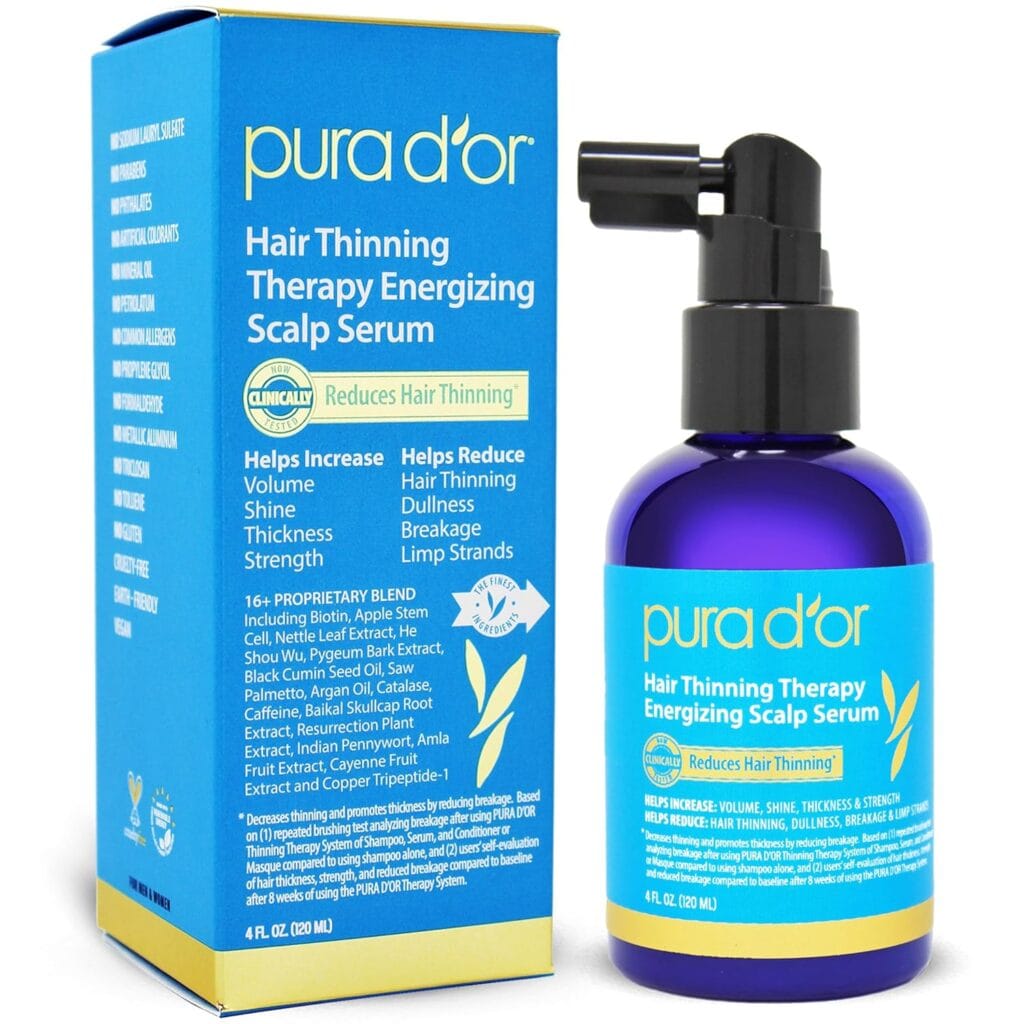
4. PURA D’OR Hair Thinning Therapy Energizing Scalp Serum (4oz)
⭐ Best for: Advanced thinning | DHT-related hair loss | Maximum ingredient formula | Sensitive scalps
If you’ve tried basic rosemary oils and want something more powerful — this is your next step. PURA D’OR’s scalp serum doesn’t just contain rosemary oil (Rosmarinus Officinalis Leaf Oil) — it pairs it with a 16+ ingredient proprietary blend that targets hair thinning from every possible angle simultaneously.
The ingredient list reads like a who’s who of evidence-backed hair growth actives: Copper Tripeptide-1 for follicle repair, Biotin for keratin production, Caffeine to stimulate follicles, Saw Palmetto for DHT blocking, Catalase Enzyme to combat oxidative stress, and Argan, Amla, and Black Cumin Seed oils for deep scalp nourishment. All wrapped in a formula that is completely free from sulfates, parabens, silicones, and common allergens.
Why we love it: Over 8,000 verified reviews and an Amazon’s Choice badge — this is one of the most trusted hair growth serums on Amazon, full stop. The pump applicator delivers precise, mess-free application directly to the scalp. No diluting, no mixing, no prep.
Who it suits: Anyone dealing with moderate to advanced thinning, DHT-related hair loss, or a sensitive scalp that reacts to fragranced products. Gluten-free and hypoallergenic — suitable for people who struggle with most scalp treatments.
What to know: This is a premium-priced product — but the formula justifies it. If you want one product that covers rosemary oil, DHT blocking, biotin, and scalp repair all in one bottle, this is the most complete option on this list.
Best Rosemary Oil on AliExpress: Budget-Friendly Picks
AliExpress offers excellent value for rosemary oil — particularly for pure essential oils and larger quantities. Allow 2–3 weeks for standard shipping.
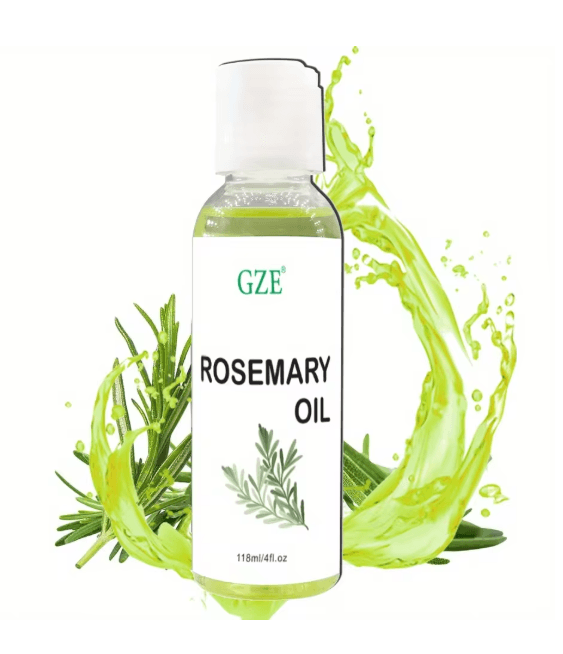
5. GZE Rosemary Essential Oil — Natural Hair Growth Serum (118ml/4fl.oz)
⭐ Best for: Pure rosemary oil seekers | Hair loss + thinning | Budget-conscious buyers | Verified results
If you want rosemary oil in its most straightforward, no-fuss form — this is it. GZE’s rosemary essential oil is formulated specifically for three things: reducing hair loss, purifying the scalp, and improving circulation. No extra ingredients clouding the formula. Just concentrated rosemary oil doing exactly what the research says it does.
Why we love it: 4.7 stars across 80 verified purchase reviews — every single review is confirmed real, not incentivized. With 466 orders sold and real customer photos showing the product in hand, this is one of the most trustworthy rosemary oil options on AliExpress right now. The 118ml bottle gives you more product per rupee than most competitors.
Who it suits: Anyone who wants a pure rosemary oil without a blended formula — ideal for people who already have a carrier oil they love and want full control over their dilution ratio.
What to know: This is a concentrated serum — dilute before applying directly to scalp. Mix 2–3 drops with a tablespoon of jojoba or coconut oil before your scalp massage.
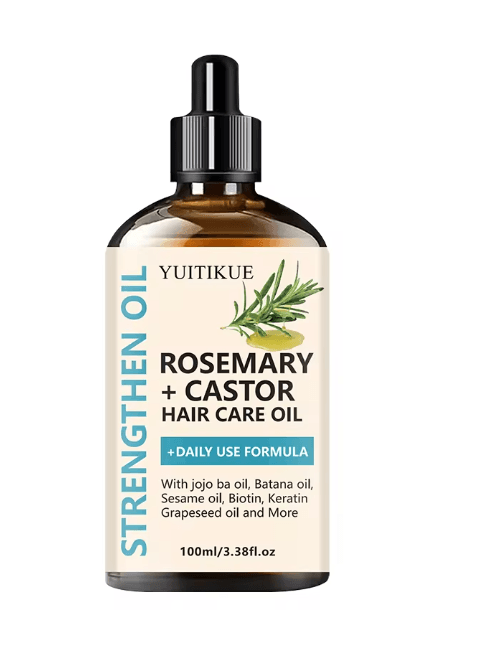
6. YUITIKUE Rosemary + Castor Strengthening Hair Oil (100ml)
⭐ Best for: Daily use | Pre-blended & ready to apply | Budget buyers | Multi-ingredient treatment
Most rosemary oils give you one or two active ingredients. This one gives you seven. YUITIKUE’s strengthening blend combines rosemary, castor oil, jojoba, batana oil, sesame oil, biotin, keratin, and grapeseed oil into one daily-use formula — pre-blended, pre-diluted, and ready to apply directly to your scalp. No measuring, no mixing, no separate carrier oil purchase. Just open and use.
Why we love it: 4.9 stars across 61 verified reviews and 499 orders sold — this is one of the most trusted rosemary oil blends on AliExpress right now. The multi-oil formula means you’re not just stimulating hair growth — you’re strengthening existing strands, improving scalp health, and adding serious shine all in one step. The value is genuinely hard to beat.
Who it suits: Anyone who wants a complete scalp treatment without building a routine from scratch. Especially good for dry, damaged, or colour-treated hair that needs more than just growth support.
What to know: Castor oil is on the heavier side — if you have fine or naturally oily hair, start with every other day rather than daily, and adjust based on how your scalp responds.
How to Choose the Right Rosemary Oil: Pure Essential Oil vs. Pre-Made Serum
Not sure which format to buy? Here’s the honest breakdown:
Pure Essential Oil | Pre-Made Serum / Blended Oil | |
|---|---|---|
Price | Lower | Higher |
Ease of use | Requires diluting | Ready to use |
Control | Full control over strength | Fixed formulation |
Best for | Experienced users, budget buyers | Beginners, busy routines |
Shelf life | 2–3 years | Check product label |
Carry-on friendly | Yes (if under 100ml) | Check volume |
The bottom line: If you’re new to rosemary oil, a pre-made option like Mielle or PURA D’OR removes all the guesswork. If you’re comfortable with essential oils and want maximum value, a pure oil like Handcraft or NOW gives you more treatments per pound spent.
How Often Should You Use Rosemary Oil?
- For scalp massage treatments: 2–3 times per week is the research-backed frequency. Daily use is generally safe but unnecessary — and can make hair feel greasy if you’re using heavier carrier oils.
- For shampoo mixing: Daily is fine. The concentration per use is low and rinses out.
- For rosemary water spray: Daily use is safe and beneficial. It’s the lightest application method and can be used every morning as part of a consistent routine.
- General rule: Consistency over intensity. Three times a week for six months beats daily use for three weeks and then stopping. Hair growth is a long game.
Rosemary Oil Side Effects and Precautions
Rosemary oil is well-tolerated by most people — but there are things to know before you start.
- Always dilute. Applying undiluted essential oil directly to the scalp can cause contact dermatitis, redness, or chemical irritation. The standard safe dilution is 2% — that’s approximately 2 drops of essential oil per teaspoon of carrier oil.
- Patch test first. Apply your diluted mixture to the inside of your wrist and wait 24 hours before applying to your scalp. This identifies any sensitivity before it becomes a scalp-wide reaction.
- Avoid contact with eyes. Essential oils near the eyes cause significant irritation. Apply to the scalp only, not the hairline near the eyes.
- Pregnancy. Rosemary oil in culinary amounts is safe during pregnancy, but concentrated essential oil applied topically is generally advised to be avoided, particularly in the first trimester. Consult your healthcare provider.
- Epilepsy. Rosemary oil contains camphor and 1,8-cineole, which at high concentrations have been linked to seizure activity in sensitive individuals. If you have epilepsy or a seizure disorder, consult a physician before using rosemary oil topically.
- Medication interactions. If you are on blood-thinning medications, consult your doctor — rosemary oil has mild anticoagulant properties.
For the vast majority of healthy adults, rosemary oil is extremely safe. These precautions are worth knowing, not worth panicking about.
Frequently Asked Questions
Your Hair Growth Journey Starts With One Consistent Habit
Rosemary oil is not magic. It won’t grow an inch of hair overnight. But it is one of the most evidence-backed, affordable, and genuinely safe natural interventions available for hair thinning and slow growth — and that combination is rare. The people who see results are the ones who pick a method, use it consistently, and give it time. That’s it. That’s the whole secret.
Start simple: grab one of the picks from our Amazon or AliExpress list above, commit to the scalp massage method twice a week, and give it three months before you judge the results. Most people are genuinely surprised.
Save this article to your Pinterest boards and bookmarks — it’s the only rosemary oil guide you’ll need to refer back to. Share it with a friend dealing with thinning or slow growth. And when you’re ready for more honest, research-backed beauty guidance, you know where to find us at The Glow Genius.