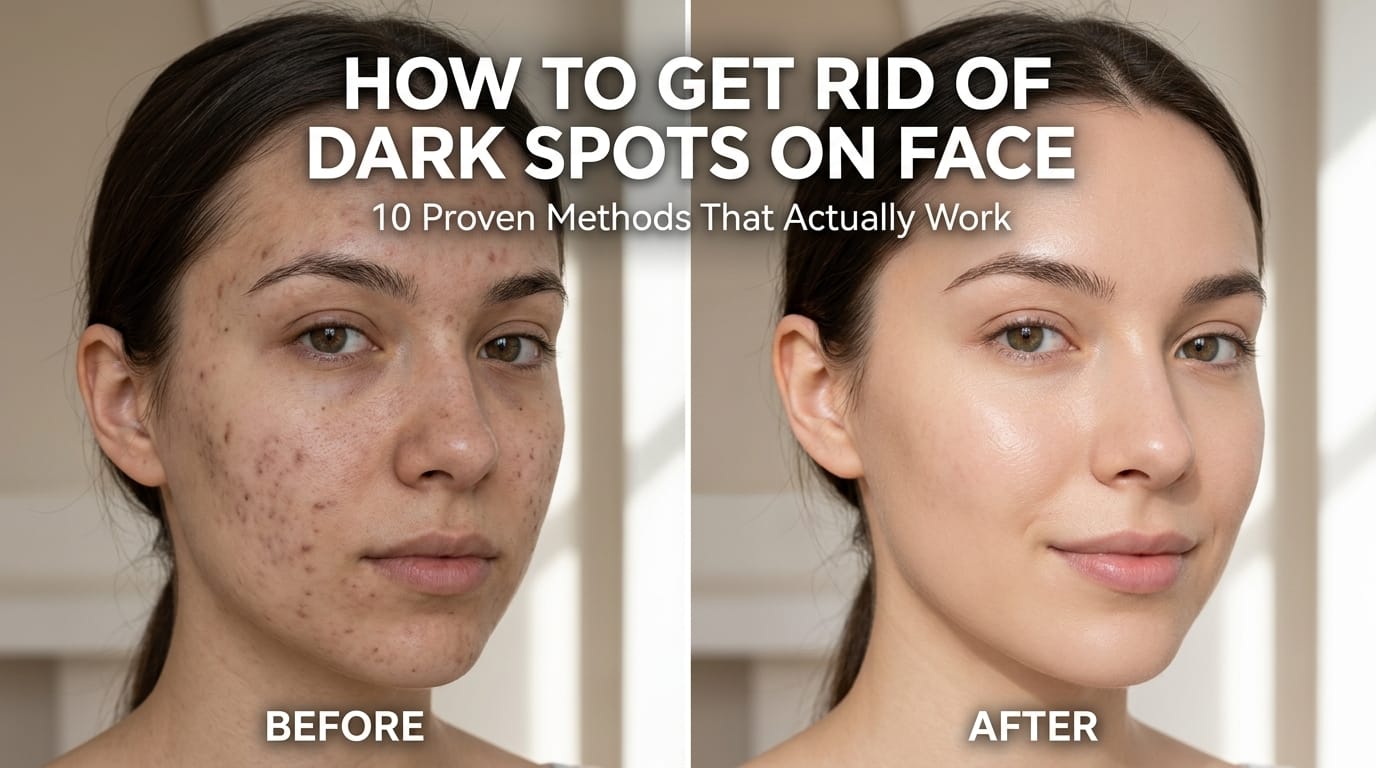
How to Get Rid of Dark Spots on Face: 10 Proven Methods That Actually Work
Dark spots don’t just show up on your skin. They show up in how you feel getting dressed in the morning. The way you angle your face in photos, the way you reach for full-coverage foundation before you feel ready to leave the house. The way a bad skin day quietly becomes a bad everything day. If that sounds familiar — this article is written for you. How to get rid of dark spots on face is one of the most searched skincare questions in the world — and yet most people are still stuck, still frustrated, still cycling through products that don’t deliver.
The reason? They’re treating symptoms without understanding causes. Hyperpigmentation triggered by UV damage needs a completely different approach than post-acne marks caused by post-inflammatory melanin response. And both are different from hormonal melasma.
This guide covers all four types, five home remedies for how to get rid of dark spots on face with real science behind them, five dermatologist-approved ingredients, a daily AM and PM skincare routine, and a brutally honest results timeline. Everything in one place. Keep reading — and finally get some answers.
Ready to take your results even further? Looking for the best serums to fade dark spots faster? We’ve tested and ranked the top picks — check out our full guide here: theglowgenius.com/fade-dark-spots/
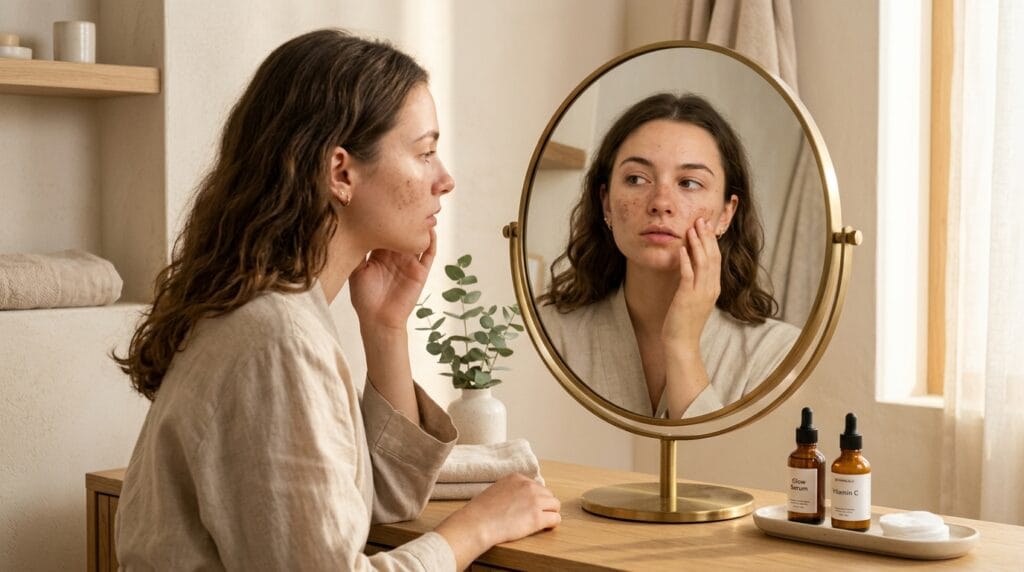
What Are Dark Spots On Face and Why Do They Happen?
Before you treat them, you need to know what you’re actually dealing with
Not all dark spots on face are the same — and treating the wrong type with the wrong approach is one of the biggest reasons people don’t see results when trying to figure out how to get rid of dark spots on face. Hyperpigmentation is the umbrella term for any area of skin that produces more melanin than surrounding skin, creating a darker patch. But what triggers that excess melanin production varies significantly. Here are the four main types you need to know:
- Sun Spots / Age Spots (Solar Lentigines) These are flat, brown or tan patches that develop on areas frequently exposed to the sun — your cheeks, nose, forehead, and hands. UV radiation stimulates melanocytes (the cells that produce melanin) into overdrive, causing concentrated pigmentation to develop over time. They tend to appear more commonly after your late twenties and increase with cumulative sun exposure. The key identifier: they don’t hurt, they don’t change texture, and they appear specifically on sun-exposed areas.
- Post-Acne Marks (Post-Inflammatory Hyperpigmentation / PIH) Every time your skin experiences inflammation — from a pimple, a cyst, or even aggressive scratching — it triggers a wound-healing response that can leave behind a dark mark even after the breakout itself has healed. Post-inflammatory hyperpigmentation is extremely common in medium to deeper skin tones, where melanin production in response to inflammation is naturally higher. These marks are flat (not raised or textured) and fade on their own over time — but that time can be anywhere from a few months to over a year without treatment.
- Hormonal Pigmentation / Melasma Melasma is a specific type of hyperpigmentation triggered by hormonal changes — pregnancy, birth control pills, hormonal therapies, or simply hormonal fluctuations. It typically appears as symmetrical, blotchy patches across the cheeks, forehead, upper lip, and chin. The tricky thing about melasma is that UV exposure makes it significantly worse, and it tends to be more stubborn than other types of dark spots. It’s the one type of dark spots on face most likely to need professional treatment alongside your at-home routine.
- Injury or Friction Marks Any kind of repeated friction — from glasses frames, tight clothing, or even habitual face-touching — can cause localized hyperpigmentation over time. Similarly, cuts, burns, insect bites, or any skin injury can leave behind a dark mark during healing. These are essentially the same mechanism as PIH, just triggered by physical rather than inflammatory trauma.
Why does this matter for treatment? Because sun spots respond beautifully to Vitamin C and AHA exfoliants. PIH fades well with niacinamide and alpha arbutin. Melasma needs consistent SPF above everything else. Knowing your type means you can target your treatment instead of throwing everything at the wall.
5 Home Remedies for Dark Spots On Face That Have Science Behind Them
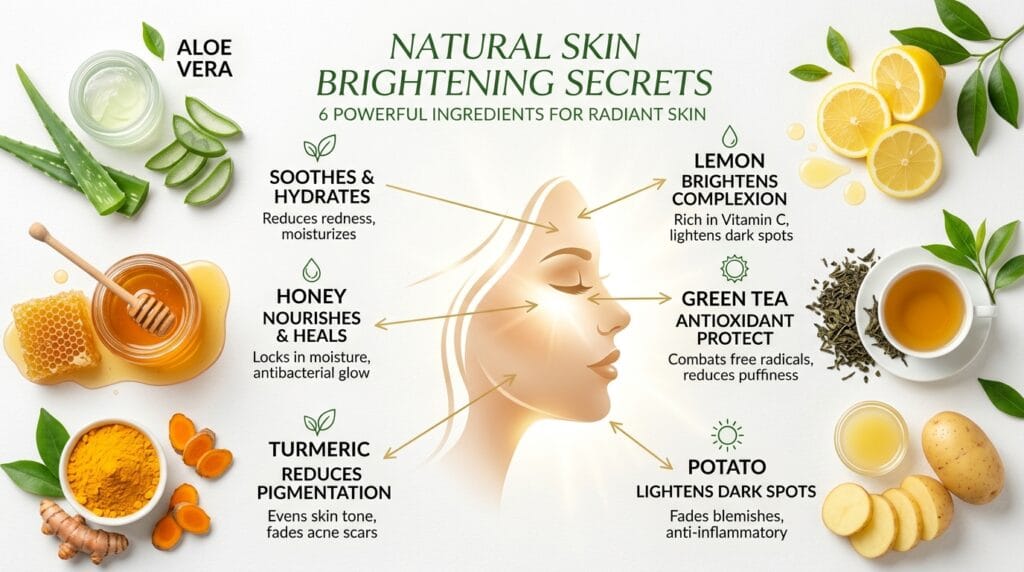
Before we get into active skincare ingredients, let’s talk about dark spot treatment at home using natural remedies that have genuine — not just anecdotal — backing. These are some of the most effective ways to learn how to remove dark spots naturally without spending a fortune. They won’t work as fast as a prescription cream, but they’re gentle, affordable, and genuinely effective when used consistently
1. Aloe Vera
Aloe barbadensis gel contains a compound called aloesin, which has been shown to inhibit tyrosinase — the enzyme responsible for producing melanin in the skin. Less tyrosinase activity means less pigment production, which means existing dark spots fade more slowly and new ones are less likely to form.
How to use it: Apply fresh aloe vera gel (straight from a leaf or a pure, additive-free gel) directly onto clean skin. Focus on dark spots specifically or use it as an all-over treatment. Use this daily — morning or night, or both. It’s gentle enough for daily use on all skin types.
Who should avoid it: Very few people react to pure aloe vera, but if you have a known latex allergy, do a patch test first as aloe and latex share some compounds.
2. Turmeric + Honey Mask
Curcumin — the active compound in turmeric — has well-documented anti-inflammatory and antioxidant properties, and research shows it can inhibit melanin synthesis. Raw honey adds antimicrobial and humectant properties, helping the skin heal and stay hydrated while the turmeric works.
How to use it: Mix half a teaspoon of turmeric powder with one teaspoon of raw honey into a paste. Apply to dark spots or use as a face mask, leave for 10–15 minutes, then rinse thoroughly with warm water. Use this mask for 2–3 times per week.
Who should avoid it: Anyone with a turmeric sensitivity or allergy. Also be warned — turmeric will temporarily stain very fair skin yellow if left on too long. Rinse well and don’t use it right before an important event.
3. Lemon Juice
Lemon juice contains citric acid (a natural AHA) and Vitamin C, both of which have genuine brightening and exfoliating properties. On paper, it sounds perfect for dark spot removal. In practice, it comes with real risks.
How to use it: If you choose to use it, always dilute — mix equal parts lemon juice and water, apply with a cotton pad to specific dark spots only (not all over the face), leave for no more than 5 minutes, and rinse thoroughly. Maximum once or twice a week — and never before sun exposure.
Who should avoid it: Anyone with sensitive skin, rosacea, or eczema should skip this entirely. Undiluted lemon juice on skin can cause chemical burns, photosensitivity, and worsen pigmentation through a reaction called phytophotodermatitis. If your skin tingles or burns at any point — rinse immediately.
4. Potato Juice
Raw potatoes contain catecholase — an enzyme that has mild skin-lightening properties — as well as Vitamin C and natural starch that soothes inflammation. It’s one of the gentler natural options and is particularly well-suited for sensitive skin that can’t tolerate acids.
How to use it: Grate a raw potato and squeeze out the juice, or simply rub a raw potato slice directly onto dark spots. Leave for 15–20 minutes, then rinse with cool water. You will use this daily — it’s gentle enough.
Who should avoid it: Those with a nightshade sensitivity. Otherwise, it’s one of the safest options on this list.
5. Green Tea Toner
Green tea is rich in EGCG (epigallocatechin gallate) — a powerful antioxidant that neutralizes free radical damage (one of the drivers of sun-induced pigmentation) and has shown mild inhibition of melanin production. It also has significant anti-inflammatory properties, making it helpful for PIH specifically.
How to use it: Brew a strong cup of green tea, let it cool completely, then apply with a cotton pad as a toner after cleansing. You can also store it in the fridge for up to three days for a cooling, refreshing application. Use this daily — morning or night.
Who should avoid it: Almost nobody. Green tea toner is one of the most universally tolerated natural treatments on this list. If you’re caffeine-sensitive, use it in the morning rather than at night.
5 Skincare Ingredients Dermatologists Recommend for Dark Spots On Face
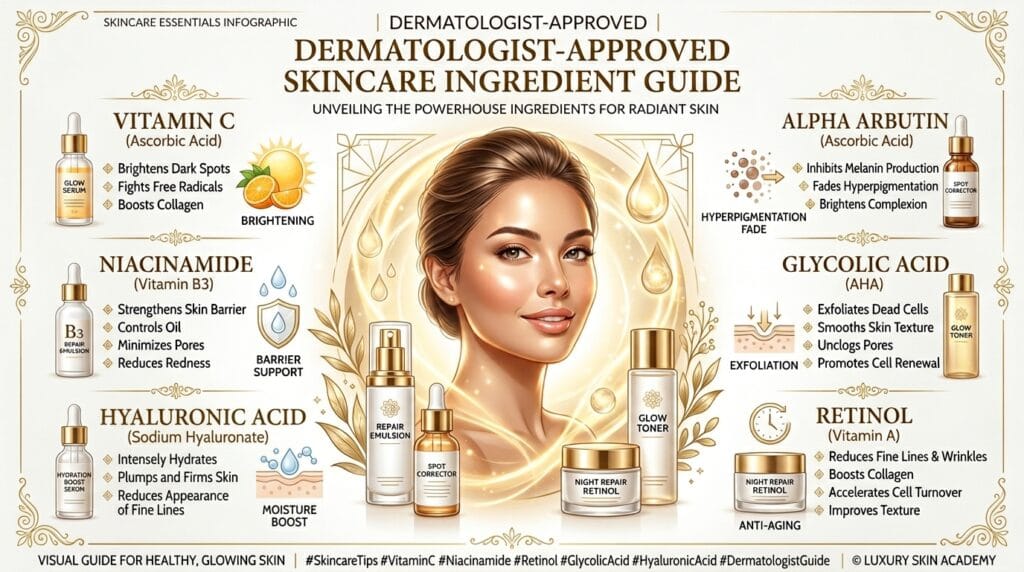
If you want to know how to get rid of dark spots on face more efficiently — with results you can actually see — these are the five ingredients that dermatologists consistently recommend for dark spots on face.
1. Vitamin C
L-ascorbic acid (the active form of Vitamin C) is one of the most well-researched brightening ingredients in skincare. It works by inhibiting tyrosinase, neutralizing free radicals from UV exposure, and gradually fading existing hyperpigmentation while preventing new spots from forming. It also boosts collagen synthesis as a bonus.
Best for: All skin types — but particularly effective for sun spots and uneven skin tone. Those with oily or combination skin tend to tolerate higher concentrations well.
Beginner tip: Start with a 10% Vitamin C serum before moving to 15–20%. Vitamin C oxidizes (turns orange/brown) when exposed to air and light — store your serum in a dark, cool place and replace it if it changes colour significantly.
2. Niacinamide
Niacinamide (Vitamin B3) works differently from most brightening ingredients — rather than inhibiting melanin production at the source, it blocks the transfer of melanosomes (melanin-containing structures) from melanocytes to skin cells. The result is a gradual, even fading of dark spots without irritation. It also reduces redness, minimizes pores, and strengthens the skin barrier — making it one of the most versatile ingredients in skincare.
Best for: All skin types, but especially brilliant for sensitive skin and those dealing with PIH from acne. It pairs well with almost every other ingredient.
Beginner tip: 5% niacinamide is the most studied concentration for dark spot treatment. Start there — you don’t need to go higher, and some people find very high concentrations (10%+) cause temporary flushing.
3. Alpha Arbutin
Alpha arbutin is a naturally derived compound (found in bearberry plants) that inhibits tyrosinase activity — the same mechanism as hydroquinone, but significantly gentler and safer for long-term use. It’s particularly effective for post-inflammatory hyperpigmentation and works well layered with Vitamin C for a combined brightening effect.
Best for: All skin types — including sensitive and darker skin tones where stronger acids can sometimes cause post-inflammatory hyperpigmentation paradoxically.
Beginner tip: Look for 1–2% alpha arbutin in a water-based serum. Apply it after cleansing and toning, before heavier moisturizers. It’s safe to use morning and night.
4. Glycolic Acid / AHA
Glycolic acid is an alpha hydroxy acid (AHA) derived from sugarcane. It works by dissolving the bonds between dead skin cells, accelerating cellular turnover, and bringing fresh, evenly pigmented skin to the surface faster. This makes dark spots appear lighter more quickly than most topical treatments alone. It also helps other brightening ingredients penetrate more effectively.
Best for: Sun spots, age spots, and mild PIH in skin types that tolerate exfoliation well. Particularly effective for those with dull, uneven skin tone.
Beginner tip: Start with a low-concentration product — 5–7% glycolic acid — used 2–3 times per week at night. Never use AHAs before sun exposure without SPF, as they increase photosensitivity. Always follow up with broad-spectrum SPF 50 the morning after.
5. Retinol
Retinol (a form of Vitamin A) accelerates skin cell turnover, encourages the shedding of pigmented cells, and gradually normalizes melanin distribution in the skin. It’s one of the most evidence-backed ingredients in all of skincare — with benefits extending well beyond dark spots to fine lines, texture, and overall skin health.
Best for: Sun damage, age spots, and mild-to-moderate hyperpigmentation in those who can tolerate a more active ingredient. Results are slower to appear but tend to be more lasting.
Beginner tip: Retinol causes an adjustment period — expect some dryness, flaking, and sensitivity in the first 2–4 weeks. Start with the lowest available concentration (0.025–0.1%) used once or twice a week, and build up gradually. Always use it at night — it degrades in sunlight — and always follow with SPF during the day.
Daily Skincare Routine for Dark Spots On Face
Consistency beats intensity every single time
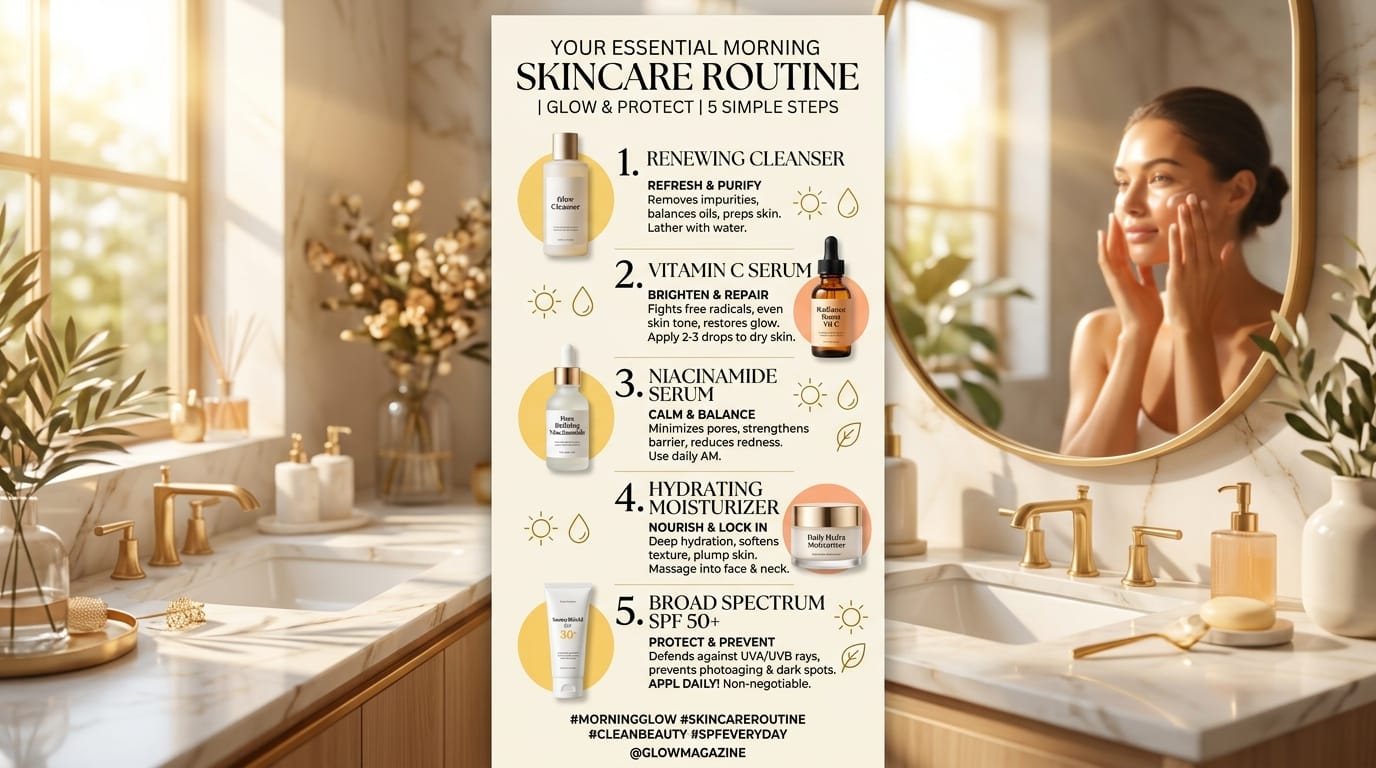
The best ingredients in the world won’t work if they’re not used consistently within a routine that supports them. Here is a simple, effective daily routine for hyperpigmentation treatment and dark spots on face — broken into morning and night:
☀️ Morning Routine
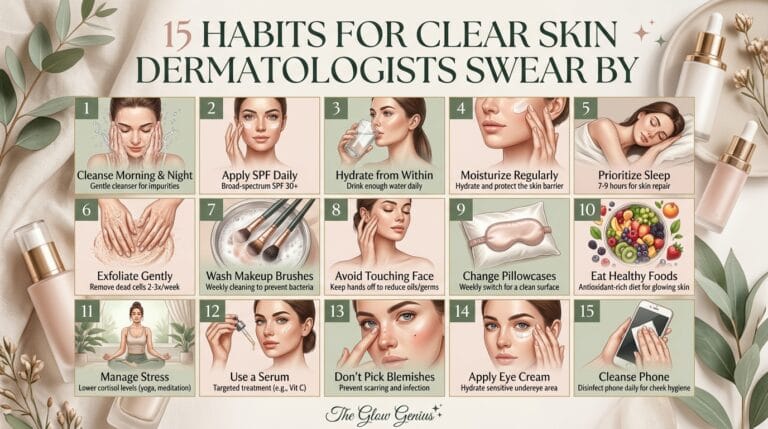
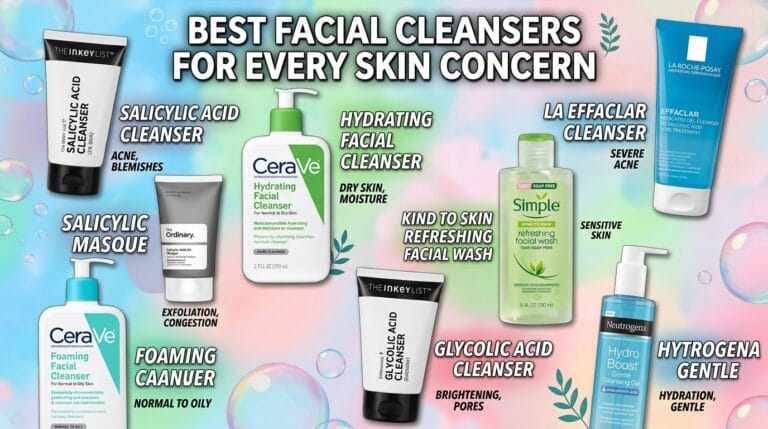
- Gentle Cleanser Start with a mild, sulfate-free cleanser that removes overnight products without stripping your skin barrier. Avoid anything with heavy fragrance — fragranced cleansers can trigger inflammation that worsens pigmentation.
- Vitamin C Serum Apply your Vitamin C serum to clean, dry skin while your skin is most receptive. Give it 60 seconds to absorb before moving to the next step. Budget-friendly option: The Ordinary Ascorbyl Glucoside Solution 12% or TruSkin Vitamin C Serum.
- Niacinamide Serum (Optional Layer) If you want to double up on brightening, layer a niacinamide serum after Vitamin C has absorbed. These two ingredients work well together despite what older skincare advice suggested.
- Lightweight Moisturizer Lock in hydration with a non-comedogenic moisturizer. Hydrated skin processes active ingredients more effectively and maintains a healthy skin barrier — essential for pigmentation recovery.
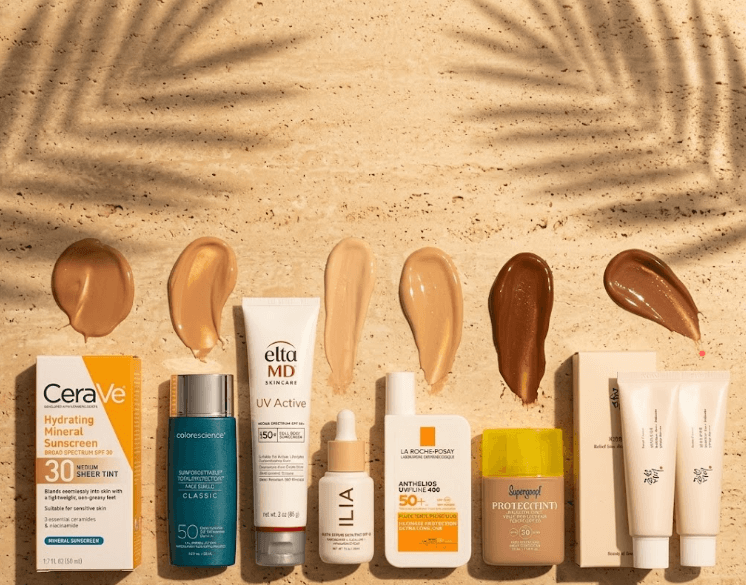
- SPF 50 Broad-Spectrum Sunscreen This is the single most important step in any dark spot routine. UV exposure is the primary driver of all four types of hyperpigmentation — and without daily SPF, every brightening ingredient you apply is fighting an uphill battle. Apply generously. Reapply every two hours if outdoors. Non-negotiable.
Budget option: La Roche-Posay Anthelios or EltaMD UV Clear.
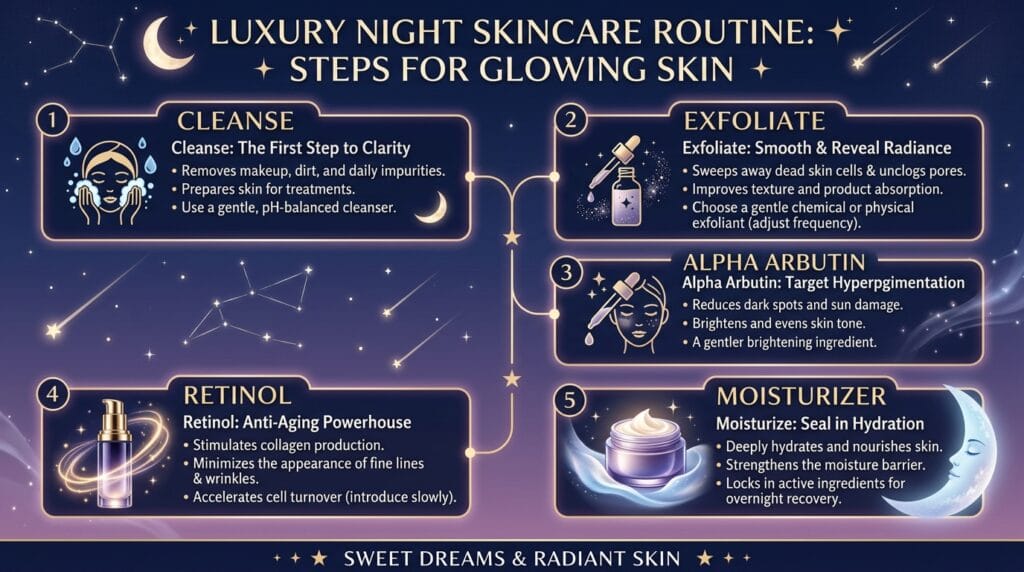
🌙 Night Routine
- Double Cleanse (If Wearing SPF/Makeup) Start with a cleansing balm or micellar water to remove SPF and makeup, followed by your regular gentle cleanser. Going to bed with SPF residue on your skin can clog pores and trigger the very breakouts that cause PIH.
- Exfoliant (2–3x per week only) On exfoliation nights, apply your glycolic acid toner or AHA serum after cleansing. Let it absorb for a few minutes. On non-exfoliation nights, skip to Step 3.
- Treatment Serum Apply alpha arbutin or niacinamide serum — or alternate between them on different nights. These are your primary dark spot treatment workhorses at night.
- Retinol (2x per week — for those ready to incorporate it) On retinol nights, apply a pea-sized amount after your treatment serum. Do not use retinol on the same night as AHA exfoliants — it’s too much actives at once and will cause irritation.
- Rich Moisturizer or Overnight Mask Finish with a nourishing moisturizer or sleeping mask. Night is when your skin does its repair work — giving it the hydration and nutrients it needs at this stage supports everything your actives are doing.
How Long Does It Take to See Results?
The honest timeline nobody talks about
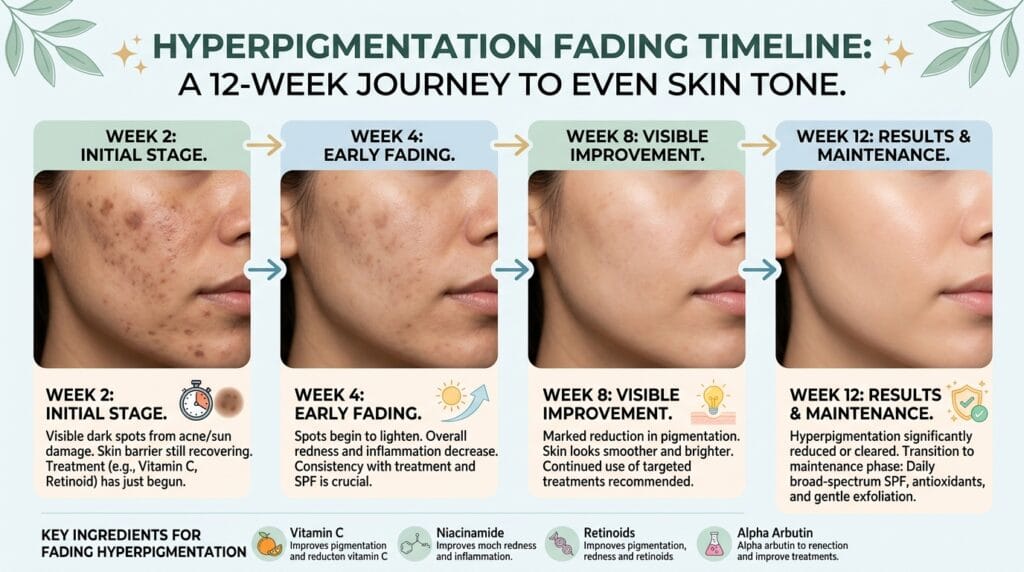
One of the most common reasons people give up on dark spot removal is unrealistic expectations. They buy a serum, use it for two weeks, see nothing, and assume it doesn’t work. If you’ve been wondering how to get rid of dark spots on face and how long it realistically takes — here is an honest, week-by-week breakdown:
- Week 2: Probably nothing visible yet — and that’s completely normal. Your skin is adjusting to new actives. If you’ve introduced retinol or glycolic acid, you may experience some dryness or mild flaking. This is the adjustment phase, not damage. Stay consistent.
- Week 4: Some people begin to notice a subtle improvement in overall skin tone and brightness. Dark spots themselves may not look dramatically different yet, but skin texture often improves noticeably. Niacinamide users tend to notice redness reduction around this time. Keep going.
- Week 8: This is typically when visible improvement in dark spots begins for most people using active ingredients consistently. Post-acne marks and mild sun spots often show meaningful fading at this stage. Vitamin C users frequently notice a more even, glowing complexion. Melasma may show some improvement but tends to respond more slowly.
- Week 12: Three months of consistent use is the benchmark most dermatologists use to evaluate a treatment’s effectiveness. By week 12, the majority of people using the right combination of ingredients see significant improvement in their dark spots. Stubborn spots — particularly deep melasma or old sun damage — may need another 12 weeks to reach their full response.
The honest truth: Some spots will fade completely. Some will fade significantly but not disappear entirely. Some — particularly deep, long-standing melasma — may always be partially visible and require ongoing maintenance rather than a one-time fix. Consistency is everything. Missing applications regularly resets your progress.
Mistakes That Make Face Dark Spots Worse
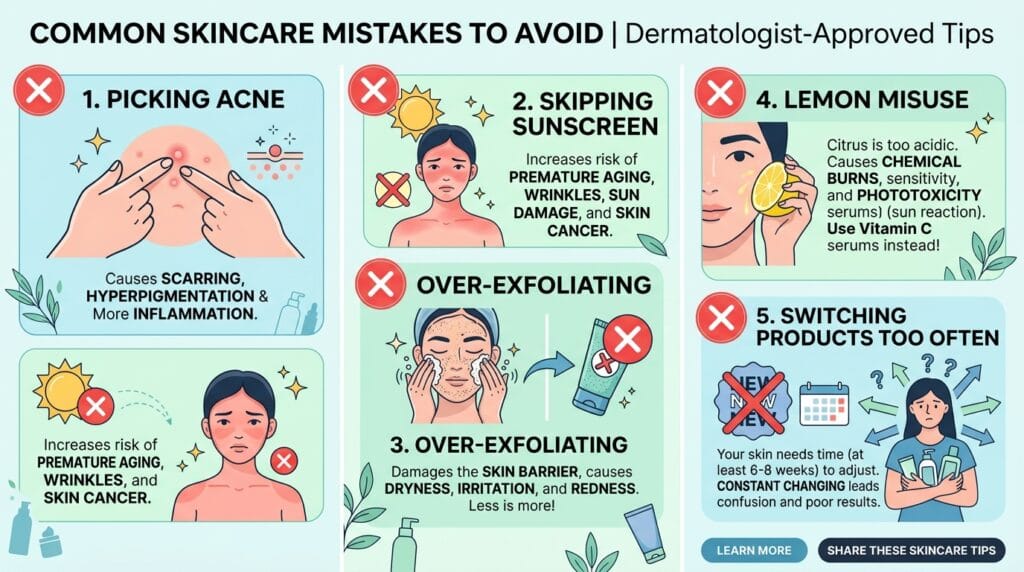
You can be using all the right products and still sabotaging your own progress. These are the six most common mistakes that keep dark spots on face stubbornly in place — and quietly undo everything you’re doing to figure out how to get rid of dark spots on face:
- Picking at Spots and Acne Every time you pick, pop, or squeeze a breakout — or pick at any healing skin — you trigger fresh inflammation and almost guarantee a post-inflammatory hyperpigmentation mark. The dark spot from the pimple you picked is almost always worse than the one you left alone. Hands off.
- Skipping SPF If there’s one mistake on this list that completely undermines everything else — it’s this one. UV exposure actively stimulates melanin production. Every morning you step outside without broad-spectrum sunscreen, you are actively darkening existing spots and creating new ones. Your brightening serum cannot outrun daily sun damage. SPF is not optional in any dark spot routine.
- Over-Exfoliating More exfoliation does not mean faster results. Using glycolic acid every day, or layering multiple acids, damages your skin barrier — causing inflammation that triggers more hyperpigmentation. Two to three times per week is the maximum for most skin types. When your skin is red, dry, or sensitive, pull back on actives entirely and focus on repair.
- Applying Lemon Juice Undiluted Undiluted citrus juice on skin is genuinely harmful — not just ineffective. It can cause phytophotodermatitis (a reaction to citrus compounds + UV light that causes intense darkening), chemical burns on sensitive areas, and paradoxical worsening of the very spots you’re trying to treat. If you use lemon juice, always dilute it and never go in the sun afterwards.
- Expecting Overnight Results and Switching Products Too Often Switching to a new serum every two to three weeks because “it’s not working” is one of the most counterproductive habits in skincare. Skin cell turnover takes 28–40 days — you cannot see the results of a new ingredient in less than that time. Commit to a product for a minimum of eight weeks before evaluating.
- Applying Active Ingredients to Dry, Barrier-Compromised Skin If your skin is already red, flaking, or sensitized from over-exfoliation or a compromised barrier, applying Vitamin C, retinol, or acids will cause burning and worsen pigmentation through inflammation. The first step in that situation is always to repair the barrier — gentle cleanser, plain moisturizer, SPF — and wait until skin is calm before reintroducing actives.
When to See a Dermatologist?
Home remedies and over-the-counter ingredients can do a lot for dark spots on face. But there are specific situations where a dermatologist’s input will save you months of trial and error — especially when standard how to get rid of dark spots on face advice simply isn’t enough:
- If your dark spots are changing. Any spot that is growing, changing color, developing an irregular border, or becoming raised should be evaluated by a professional without delay. This is not to cause alarm — the vast majority of dark spots are entirely harmless — but changes in a spot are always worth a professional look.
- If you have melasma that isn’t responding. Melasma is the most treatment-resistant type of hyperpigmentation, and a dermatologist can prescribe treatments — like hydroquinone, tretinoin, or combination formulas — that aren’t available over the counter and can make a significant difference where store-bought products have plateaued.
- If you want faster, more dramatic results. Professional treatments — chemical peels, laser therapy (IPL / Intense Pulsed Light), and microneedling — can accelerate dark spot fading significantly beyond what topical products alone can achieve. These aren’t necessary for everyone, but if you’ve been consistent with a home routine for three to six months and are still unhappy with your results, it’s a reasonable next step.
- See a dermatologist if you’re unsure what type of dark spot you have. Correct identification means correct treatment. A quick consultation removes all the guesswork and gets you on the right path immediately.
Your Clearest Skin Is a Few Consistent Habits Away
Dark spots on face are frustrating. They’re persistent. And they have a way of making you feel like no matter what you do, your skin will never look the way you want it to. But the truth — backed by both research and thousands of real people’s skin journeys — is that knowing how to get rid of dark spots on face is absolutely achievable with the right approach and realistic expectations.
Here’s what to take away from this guide: understand your dark spot type before you treat it. Use the home remedies that have genuine science behind them. Build a simple, consistent routine around Vitamin C, niacinamide, alpha arbutin, and SPF. Be patient with the timeline. And stop making the mistakes that are quietly undoing your progress.
Most importantly — be consistent. Not perfect. Consistent. A simple routine done every day will always outperform a complicated routine done occasionally.
Your skin is already doing its best. Now you know how to help it. 🌟
Ready to take your results even further? Looking for the best serums to fade dark spots faster? We’ve tested and ranked the top picks — check out our full guide here: theglowgenius.com/fade-dark-spots/