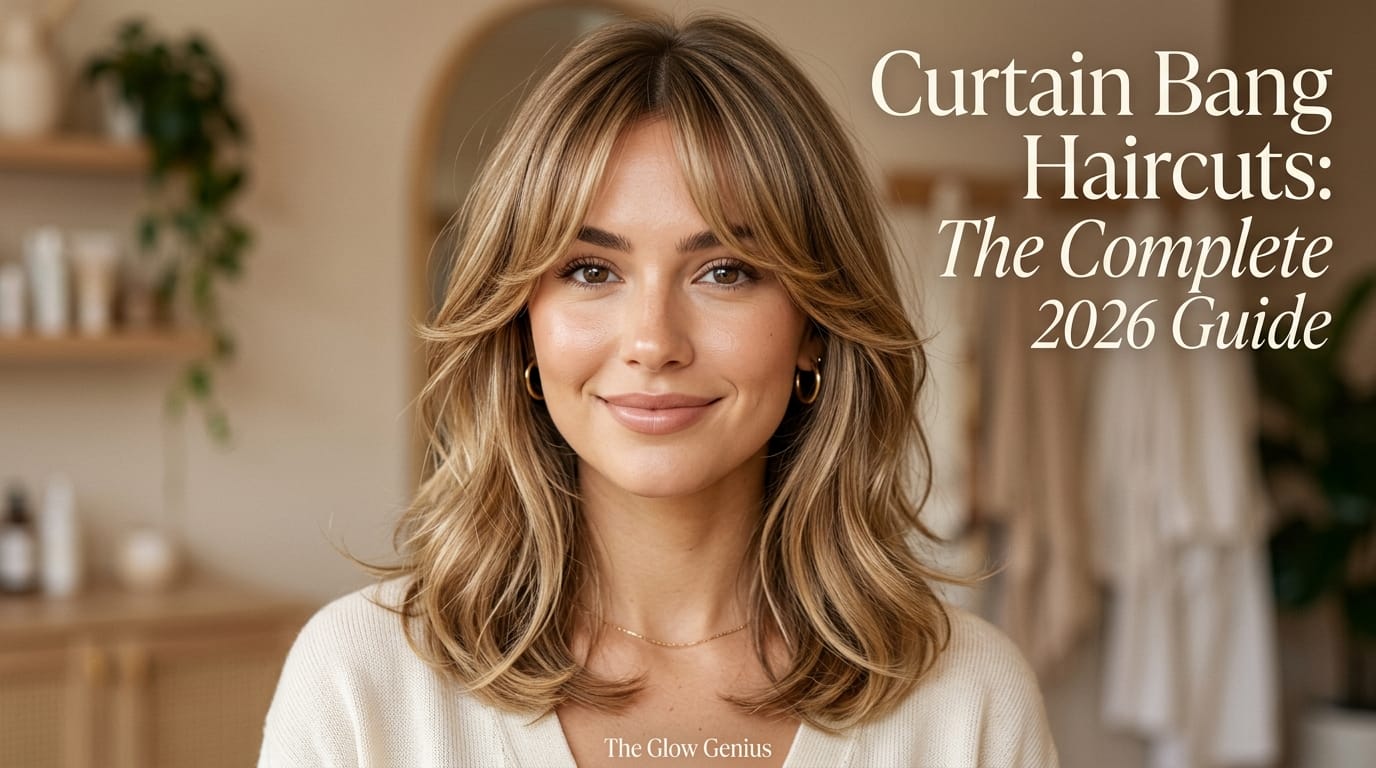
Curtain Bang Haircuts: The Complete 2026 Guide to Soft, Face-Framing Bangs
All Curtain bang haircuts recommendations on The Glow Genius are independently researched by our editors to help you make the best beauty decisions.
Curtain bang haircuts are breaking Pinterest records right now. Saves are up 800% this month, making them one of the fastest-growing hair trends of 2026.
What makes curtain bangs different from classic full bangs is the parting. Full bangs sit as one solid block across the forehead. Curtain bangs, however, part down the middle and sweep outward on each side, framing the face like an open curtain.
This single difference changes everything. Because curtain bangs leave the centre of the forehead visible, they suit far more face shapes than a blunt fringe ever could. They also blend more easily into longer hairstyles with bangs, which is why so many women are switching over right now. Here is the complete guide.
What Makes Face-Framing Bang Styles So Popular Right Now
Curtain bang haircuts suit more face shapes than full bangs because they are built around movement, not coverage. A full fringe sits flat and static. Curtain bangs, by contrast, curve outward and create soft, face-framing lines on either side of the forehead.
This soft movement is the entire appeal. Because the fringe sweeps away from the centre, it adds dimension without hiding the eyes or eyebrows. As a result, the face looks softer and more open, rather than boxed in by a heavy line of hair.
Curtain bangs also work on both straight hair and wavy hair, which is rare for a fringe style. On straight hair, they fall sleek and defined. On wavy hair, the natural texture adds extra lift and softness to the curtain shape. Therefore, almost anyone can adapt this trend to their own natural texture without constant heat styling.
This versatility is exactly why curtain bangs hairstyles are dominating searches in 2026. They are not a one-size style. They are a flexible framework that adjusts to the person wearing them.
Is the Soft Fringe Inspiration Right for Your Face Shape?
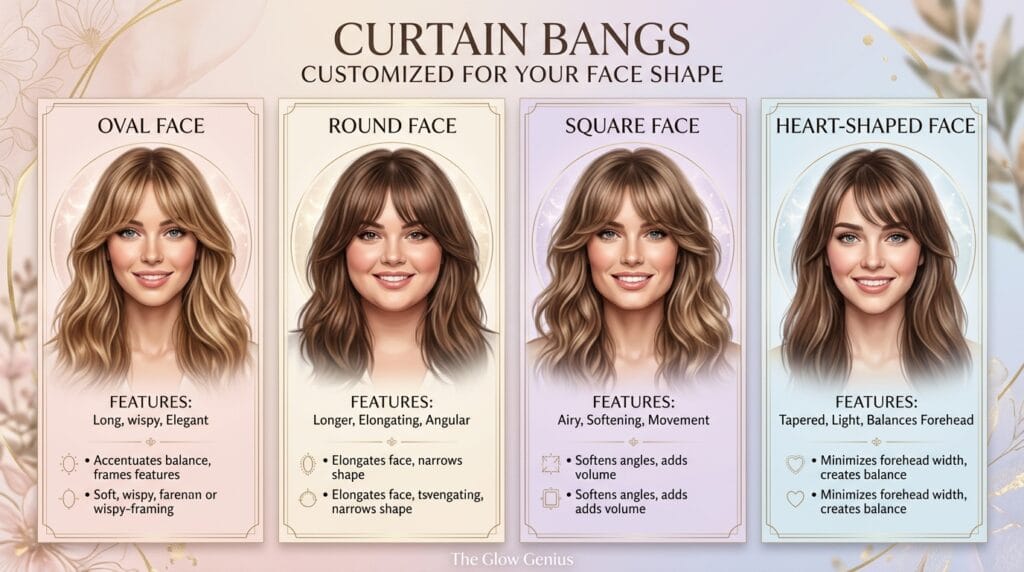
Curtain bang haircuts flatter every major face shape, though the ideal length and parting shift slightly for each one. Here is exactly how to customise them.
- Oval face shapes suit almost any version of curtain bangs because the face already has balanced proportions. A hairdresser can cut these slightly longer, reaching the cheekbones, since an oval face has room to spare. This length keeps the soft, sweeping movement that defines the style.
- Round face shapes benefit from longer, more angled curtain bangs that graze just past the chin. This length elongates the face visually. Ask your hairdresser to add subtle layers within the bang section, which helps avoid extra width near the cheeks.
- Square face shapes look softer with wispy, lightly textured curtain bangs that hit around the cheekbone. These bangs ease the strong angle of the jawline. A hairdresser can thin the ends slightly using a razor technique, which keeps the line from looking too blunt or heavy.
- Heart face shapes, which are often wider at the forehead and narrower at the chin, suit curtain bangs that start a little further back from the centre side part. This reduces width at the top of the face. Request face-framing pieces that taper gradually rather than starting abruptly.
In every case, the key conversation to have with your hairdresser is about customising the length, not just the shape, since length is what controls how the curtain effect falls against your specific bone structure.
Wispy Bang Ideas for 2026 — By Hair Type
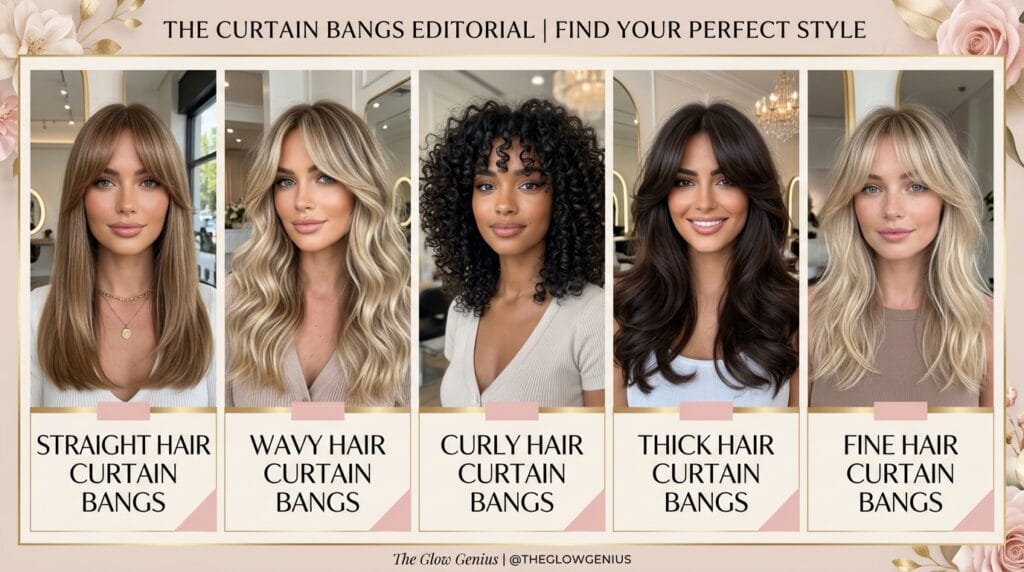
Curtain bang haircuts behave differently depending on hair type, and knowing this in advance helps you ask for the right cut.
- Straight hair holds the curtain shape with the least effort. The bangs fall cleanly into their part and require only a quick blow dry to maintain shape throughout the day. This makes curtain bangs straight hair combinations some of the lowest-maintenance options on this list.
- Wavy hair adds natural texture and volume to the curtain shape, often without any styling tools at all. However, wavy hair can sometimes push the bangs slightly off-centre. Ask your hairdresser to cut slightly longer pieces so the natural wave pattern has room to settle into place.
- Curly hair needs the most customisation. Because curls shrink upward significantly when they dry, curtain bangs on curly hair should be cut noticeably longer than the desired finished length. A skilled hairdresser will often cut curly curtain bangs dry, rather than wet, to see exactly how the curl pattern will fall.
- Thick hair can carry a fuller curtain shape with more weight in each side. Fine hair, on the other hand, usually looks better with slightly shorter, wispier curtain pieces, since too much length can make fine strands look flat and stringy. In both cases, requesting thin, feathered ends rather than one blunt line keeps the bangs looking soft regardless of density.
How to Style Curtain Bangs Step by Step
Curtain bang haircuts look their best with a simple five-step styling routine. Once you learn this sequence, the whole process takes under ten minutes.
Step 1. Section the bangs away from the rest of the hair using a clip. This keeps your styling focused and prevents the rest of your hair from getting in the way while you work on the face-framing pieces.
Step 2. Blow dry the bangs using a round brush, pulling the brush outward and slightly downward on each side. This outward motion is what creates the signature open curtain shape, rather than a flat, forward-falling fringe.
Step 3. Apply a small amount of texturizing spray to the mid-lengths of the bangs. This adds hold and grip without making the hair feel stiff or crunchy, which keeps the wispy movement intact.
Step 4. If you want extra softness, wrap each side of the bangs loosely around a curling iron for two to three seconds. This light wave adds movement, especially useful for straight hair that tends to fall very flat.
Step 5. Set the finished shape with a light-hold spray, holding the can at least 30cm away from your face. This locks the curtain shape in place for the day without weighing the bangs down.
Because heat styling can be tough on the delicate, fine hairs that often make up curtain bangs, using a heat protectant beforehand is always worth the extra thirty seconds.
The Effortless Bangs Guide — Growing Them Out Without the Awkward Stage
Curtain bang haircuts can be grown out gracefully with a few simple tricks, even during the trickiest in-between lengths.
Bobby pins are the easiest tool for the awkward stage. Crisscrossing two pins just behind the face-framing pieces holds growing bangs away from the eyes while still looking intentional, rather than simply pushed back out of frustration.
Headbands work especially well once the bangs reach eyebrow length and start to feel unmanageable. A fabric or thin headband sweeps the growing pieces back smoothly, blending them into the rest of the hair until they are long enough to tuck behind the ears.
Side-sweeping is the most natural-looking option once the bangs pass the cheekbone. Using a small amount of texturizing spray, simply sweep both sides toward a deep side part, allowing the growing out bangs to mimic long, face-framing layers instead of looking like an obvious fringe.
Finally, regular trim appointments, even just a tiny half-centimetre trim every four to six weeks, keep the curtain shape neat without sacrificing growth. This small maintenance step is what separates a smooth growing-out phase from an awkward one.
Quick Reference Table
Face Shape | Hair Type | Recommended Bang Length | Styling Tip |
|---|---|---|---|
Oval | Straight hair | Cheekbone length | Light round brush blow dry outward |
Round | Wavy hair | Just past the chin | Add layers to reduce width |
Square | Straight or wavy | Cheekbone, wispy ends | Razor-thin the ends for softness |
Heart | Fine hair | Slightly longer, taper back | Start the part further from centre |
Any shape | Curly hair | Cut longer, dry-cut | Style with a diffuser, minimal tension |
Frequently Asked Questions
Conclusion:
Curtain bang haircuts suit nearly everyone, which explains why search interest has climbed 800% this month alone. They flatter every face shape, adapt to straight hair, wavy hair, and curly hair alike, and offer a softer alternative to a full, blunt fringe.
If you have been hesitant about committing to bangs, curtain bangs are the lowest-risk way to try the trend. They grow out gracefully, blend into longer hairstyles with bangs, and never trap your face the way a heavy fringe can.
Right now, with the trend at its peak and hairdressers seeing requests for this exact cut daily, there has never been a better moment to book the appointment.
Save this guide, share it with a friend who is bang-curious, and come back anytime you need a refresher on styling or growing them out. 💇♀️